
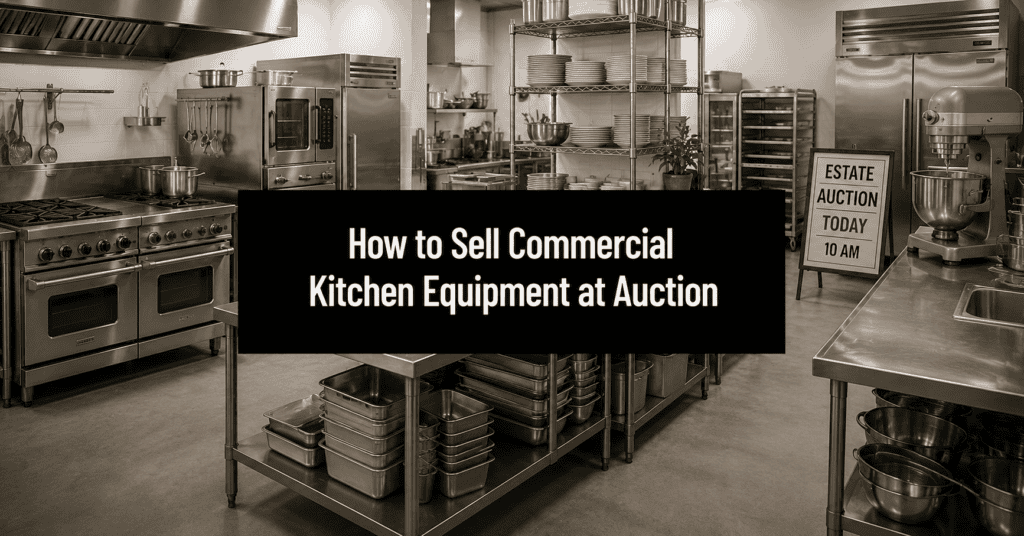
How to Sell Commercial Kitchen Equipment at Auction
Selling commercial kitchen equipment can be a major project, especially when a restaurant is closing, relocating, remodeling, downsizing, or replacing an entire line of equipment. A working kitchen may contain ovens, ranges, fryers, coolers, freezers, prep tables, mixers, shelving, sinks, dishwashing equipment, stainless steel worktables, smallwares, dining furniture, and dozens of smaller items that all need to be removed on a schedule.
An auction can give restaurant owners, property managers, landlords, lenders, business owners, and liquidators a practical way to sell those assets in an organized sale. Instead of trying to find a separate buyer for every oven, cooler, mixer, table, and rack, the equipment can be photographed, described, advertised, offered to bidders, and removed during a scheduled pickup.
The process is not as simple as taking a few pictures and listing everything online. Commercial kitchen equipment is heavy, specialized, and often connected to gas, water, electrical service, ventilation, or refrigeration systems. Buyers need accurate information about condition, dimensions, voltage, phase, fuel type, model numbers, and removal requirements. Sellers also need a plan for disconnection, access, deadlines, and property protection.
BB Realty & Auctions works with businesses and property owners across the Kansas City area and surrounding Missouri and Kansas communities who need help selling commercial assets. Depending on the size and type of operation, the sale may be handled as a dedicated equipment auction, a business liquidation, a consignment sale, or a broader property liquidation.
This guide explains how commercial kitchen equipment is prepared for auction, what information buyers want, which restaurant assets usually attract the strongest interest, how removal is handled, and what sellers can do to make the process smoother.
When a Commercial Kitchen Auction Makes Sense
A commercial kitchen auction can make sense in several situations. A restaurant may be closing permanently, a catering company may be downsizing, a school or church kitchen may be replacing equipment, a grocery store may be remodeling, or a landlord may need to liquidate property left behind by a former tenant.
Auctions are especially useful when there is a substantial amount of equipment and a defined deadline. Rather than negotiating privately with multiple buyers, the seller can place the entire kitchen in front of a larger audience and establish one organized closing and pickup schedule.
The sale may include only kitchen equipment, or it may also include dining furniture, point-of-sale systems, office furniture, decor, signs, storage racks, small appliances, cookware, serving pieces, cleaning equipment, and maintenance tools.
For some businesses, the kitchen is only one part of a larger liquidation. BB Realty & Auctions can review the broader range of assets through its general auction services and determine whether the sale should be handled as one complete event or divided into specialized groups.
Start With a Full Inventory
The first step is to identify exactly what is being sold. A commercial kitchen often contains more assets than the owner realizes because equipment is spread across cooking lines, prep areas, dish rooms, walk-in coolers, storage rooms, offices, bars, and dining spaces.
A basic inventory should include major equipment, smaller appliances, stainless steel fixtures, storage systems, utensils, serving equipment, and furniture. Model numbers, serial numbers, fuel types, and electrical requirements should be recorded whenever visible.
Common commercial kitchen auction categories include:
- Commercial ovens, convection ovens, deck ovens, and combination ovens
- Ranges, griddles, charbroilers, steam tables, and cooktops
- Deep fryers, pressure fryers, pasta cookers, and warming equipment
- Reach-in coolers, freezers, undercounter refrigeration, and prep coolers
- Walk-in cooler and freezer components
- Commercial mixers, slicers, processors, grinders, and food-prep machines
- Stainless steel prep tables, worktables, sinks, and dish tables
- Dishwashers, glass washers, and sanitation equipment
- Metal shelving, dunnage racks, carts, and storage bins
- Smallwares, cookware, sheet pans, hotel pans, utensils, and serving pieces
- Dining tables, chairs, booths, bar stools, and patio furniture
- Point-of-sale systems, printers, office equipment, and signage
The inventory does not need to be perfect before the first walkthrough. However, access to all storage rooms, refrigeration areas, and locked spaces helps the auction company understand the full scope of the project.
Gather Model Numbers, Serial Numbers, and Equipment Details
Buyers of restaurant equipment want specific information. A commercial oven is not simply an oven, and a cooler is not simply a cooler. Brand, model, size, power requirements, fuel type, age, and condition can all affect buyer interest.
Model and serial tags are commonly found behind doors, inside cabinets, on side panels, near electrical connections, or on the back of the equipment. These tags may show voltage, amperage, phase, refrigerant type, gas type, production date, and manufacturing information.
The listing should note whether the equipment uses natural gas, propane, single-phase power, three-phase power, or another electrical setup. Buyers need this information to determine whether the unit will work in their facility.
Measurements are also important. Width, depth, and height should be recorded, along with doorway restrictions and clearance requirements. A buyer may be interested in a double-stack oven but unable to remove it through a narrow rear door.
Helpful tip: Do not remove or paint over manufacturer tags. Clear model and serial information can make commercial kitchen equipment easier to identify and more attractive to serious buyers.
Document Whether the Equipment Is Working
Buyers want to know whether equipment was operating when it was removed from service. Sellers should provide accurate information without making guarantees they cannot support.
If the oven heats, the mixer runs, or the cooler maintains temperature, that information may be useful. If equipment has already been disconnected, the listing may need to state that it was not tested by the auction company. A unit can still sell as untested, but buyers will usually factor that uncertainty into their bids.
Service records, repair invoices, maintenance logs, manuals, and warranty information should be kept with the related equipment. Buyers may place more confidence in a machine when they can see that it was maintained or recently serviced.
Sellers should avoid overstating condition. Terms such as “works great” or “fully operational” should only be used when that claim can be reasonably supported. Honest descriptions and clear photos build buyer confidence and reduce disputes.
Commercial Ovens and Cooking Equipment
Commercial ovens and cooking equipment can be some of the most valuable assets in a restaurant liquidation. Convection ovens, deck ovens, pizza ovens, combination ovens, ranges, griddles, charbroilers, steamers, and holding cabinets may attract restaurants, caterers, food trucks, churches, schools, and institutional kitchens.
Strong listings identify the brand, model, number of decks or compartments, fuel type, electrical requirements, dimensions, and included accessories. Racks, trays, stands, casters, stones, and control panels should be photographed.
Grease buildup and heavy residue can hurt presentation. Basic professional cleaning may help, but sellers should not damage tags, controls, wiring, or surfaces. Equipment should be photographed honestly, including visible wear.
Fixed cooking equipment may require licensed disconnection. Gas lines, hard-wired electrical connections, hood systems, and fire-suppression components should not be removed casually. The seller should determine in advance who is responsible for disconnection and whether the buyer may use a licensed contractor during pickup.
Coolers, Freezers, and Refrigeration Equipment
Commercial refrigeration is another major auction category. Reach-in coolers, freezers, merchandisers, sandwich prep tables, undercounter units, bar coolers, ice machines, and refrigerated display cases may attract a wide range of buyers.
Buyers want to know whether the unit cools, the approximate operating temperature, the refrigerant type when visible, the number of doors, shelving configuration, voltage, and whether casters or legs are included.
Refrigeration equipment should be emptied, cleaned, and allowed to dry. Food, spills, and odors reduce buyer confidence. Doors should remain open after shutdown when appropriate to reduce mold and odor problems.
Walk-in coolers and freezers require special planning. A walk-in may include insulated panels, doors, evaporators, condensers, controls, shelving, and refrigeration components. The listing should make clear whether the buyer is purchasing only the box, only the refrigeration system, or the complete assembly.
Removal may require dismantling, licensed refrigeration work, and careful labeling of panels. A buyer should understand the schedule and whether the unit must be removed without damaging the building.
Prep Tables, Mixers, Slicers, and Food-Prep Equipment
Food-prep equipment often performs well because it can be used by restaurants, bakeries, caterers, concession operators, schools, and home-based food businesses. Commercial mixers, dough sheeters, slicers, grinders, processors, scales, and stainless steel prep tables can attract both established businesses and new operators.
Mixers should include details about bowl size, attachments, speed settings, voltage, and whether the unit is countertop or floor-standing. Bowls, dough hooks, paddles, whips, guards, and carts should stay with the machine whenever possible.
Slicers and processors should be photographed from several angles, including the blade area, controls, carriage, guards, and identification tags. Missing safety components should be disclosed.
Stainless steel prep tables are often sold individually or grouped by size. Tables with undershelves, backsplashes, drawers, casters, or integrated sinks may bring stronger interest than plain tables.
Fryers and Grease-Handling Equipment
Commercial fryers can sell well, but they require careful preparation. The oil should be removed, and the unit should be cleaned enough for safe handling. Grease left inside equipment can leak during pickup, create slip hazards, and damage vehicles or flooring.
The listing should identify the number of fry pots, fuel type, basket count, filtration system, controls, and whether the unit was operating when removed from service.
Fryer accessories such as baskets, crumb screens, drain extensions, filter pans, oil carts, and covers should be grouped with the fryer or clearly listed separately.
Used oil, grease containers, and disposal systems may require separate handling. Sellers should not assume the auction buyer will remove waste products unless that responsibility is clearly stated.
Shelving, Racks, Carts, and Storage Equipment
Metal shelving, wire racks, dunnage racks, sheet-pan racks, ingredient bins, utility carts, and mobile storage systems can attract strong practical interest. These items are useful to restaurants, warehouses, garages, schools, and retail businesses.
Shelving can be sold as complete units or grouped by size and type. Shelves, posts, clips, casters, and braces should be kept together. Missing clips or damaged shelves should be disclosed.
Large quantities of shelving may be divided into multiple lots so more buyers can participate. A small restaurant may not need forty sections of shelving, but it may be interested in four or five.
Mobile racks and carts should be photographed with their wheels, handles, shelves, and overall condition visible. If a rack is intended for specific pan sizes, that information can help buyers.
Smallwares and Restaurant Supplies
Smallwares can add substantial value to a commercial kitchen auction when they are organized properly. Pots, pans, sheet trays, hotel pans, knives, utensils, serving pieces, storage containers, glassware, dishes, cutting boards, mixing bowls, and bar supplies may be sold in grouped lots.
These items are rarely practical to list one piece at a time. Grouping by category makes the auction easier for buyers to understand and more efficient to catalog.
For example, sheet pans and cooling racks may be sold together. Hotel pans can be grouped by size. Bar glassware, utensils, and small appliances can form a separate lot. Cookware may be divided into stainless steel, aluminum, cast iron, or specialty pieces.
Clean, organized smallwares generally attract more interest than mixed boxes of dirty or unrelated items. However, sellers should avoid discarding useful pieces before the auction company has reviewed them.
Dining Room Furniture, Booths, and Decor
A restaurant liquidation may include more than kitchen equipment. Dining tables, chairs, booths, bar stools, patio furniture, host stands, menu boards, wall decor, signs, and lighting can all be included.
Matching chairs and tables are often grouped in quantities that make sense for buyers. A lot may include four tables and sixteen chairs rather than the entire dining room in one purchase.
Booths can be more difficult because they may be fastened to walls or floors. The listing should explain whether they are freestanding, how many sections are included, and who is responsible for removal.
Branded signs, custom decor, neon, vintage advertising, and themed restaurant pieces may attract collectors in addition to restaurant buyers. These items should not be discarded before the auction company sees them.
How Equipment Is Photographed and Described
Commercial equipment photography should show the entire unit and the details buyers need to evaluate it. Photos may include front, back, sides, controls, interior compartments, burners, racks, motors, model tags, electrical plugs, gas connections, and visible wear.
Large equipment should be photographed with enough space around it to show scale. Close-up photos should reveal dents, rust, cracked handles, missing knobs, damaged cords, worn seals, or other condition issues.
Descriptions should be factual and useful. A good listing may include the brand, model, approximate dimensions, voltage, phase, fuel type, operating status, included accessories, visible condition, and removal requirements.
Accurate descriptions help attract serious buyers and reduce questions. They also make the auction easier to market to restaurants, food-service operators, caterers, churches, schools, concession businesses, and commercial kitchen buyers.
Decide Who Is Responsible for Disconnection
Disconnection is one of the most important parts of a commercial kitchen auction. Some items simply unplug. Others are connected to gas, hard-wired electrical service, water, drains, refrigeration lines, ventilation systems, or fire-suppression systems.
The auction terms should clearly state whether equipment will be disconnected before the sale, whether the buyer is responsible, and whether licensed contractors are required.
Sellers should not allow unqualified buyers to disconnect gas or electrical equipment in a way that creates danger or property damage. The building owner, insurer, local rules, or lease may require professional work.
Hood systems, Ansul systems, walk-in refrigeration, large dishwashers, and permanently installed sinks may require specialized removal. These items should be evaluated individually before they are included in the auction.
Plan the Pickup Before the Auction Opens
Buyer pickup should be planned before bidding begins. Commercial kitchen equipment is heavy and often difficult to remove. Buyers need to know the pickup date, loading access, door sizes, stairs, elevator availability, dock access, and whether power or utilities will still be available.
Buyers are generally responsible for bringing enough labor, dollies, pallet jacks, forklifts, tools, trailers, trucks, straps, and protective materials. The exact responsibilities should be written in the sale terms.
The auction company may supervise pickup, verify purchases, direct traffic, and coordinate removal times. Families and buyers should review the posted auction rules and terms before removal.
Large items may require individual appointments so several buyers are not trying to remove ovens, coolers, and shelving from the same doorway at once.
The property should also be protected. Buyers should avoid dragging equipment across floors, cutting utilities without approval, damaging walls, or leaving debris behind. Clear expectations help keep the pickup organized.
What Commercial Kitchen Equipment Usually Performs Best?
Buyer demand varies, but certain categories tend to attract strong interest when they are clean, complete, and in usable condition.
Recognized Commercial Brands
Equipment from recognized commercial manufacturers often performs better because buyers are familiar with the quality, parts availability, and service support.
Clean Stainless Steel Equipment
Stainless steel prep tables, sinks, shelving, carts, and dish tables are practical and easy to reuse. Clean, sturdy stainless equipment often attracts restaurants, garages, workshops, and other businesses.
Working Refrigeration
Coolers and freezers that are documented as cooling properly can attract stronger bidding than untested units. Clean interiors and intact door seals also matter.
Complete Mixers and Prep Machines
Mixers with bowls, attachments, guards, and stands are more appealing than incomplete units. Complete accessories can significantly affect value.
Flexible, Multi-Use Equipment
Equipment that can be used by many types of food-service businesses usually has a larger buyer pool. Prep tables, racks, sinks, convection ovens, undercounter coolers, and utility carts are examples.
What Can Be Harder to Sell?
Highly specialized equipment, incomplete systems, damaged refrigeration, outdated electronics, permanently installed fixtures, and items that are extremely difficult to remove may attract fewer buyers.
Equipment with missing parts, unknown operating status, unusual voltage, severe grease buildup, or major corrosion may still sell, but expectations should be realistic.
Custom-built counters, hoods, and fixtures may have limited value outside the original space. Removal costs can exceed the value of the equipment, particularly when the buyer must repair walls, ceilings, or utilities afterward.
This is why the auction company should review the site before everything is listed. Some assets belong in the sale, while others may be better left in place, sold with the real estate, scrapped, or removed through another arrangement.
Sell as a Dedicated Auction or Through Consignment?
A full restaurant or commercial kitchen may support a dedicated auction. A smaller group of equipment may be better suited for consignment sales.
A dedicated auction gives the seller a focused event and a defined pickup schedule. Consignment can be useful when only a few items remain, such as one mixer, a prep table, shelving, or a small group of restaurant equipment.
The best option depends on quantity, value, location, timing, and removal needs. BB Realty & Auctions can review the assets and recommend a practical structure rather than forcing every project into the same format.
How the Real Estate or Lease Affects the Auction
Commercial kitchen liquidation is often connected to a lease deadline, property sale, landlord turnover, or closing date. Those dates should be discussed before the auction is scheduled.
If the building is being sold, some installed equipment may be included with the real estate rather than removed. The seller should confirm ownership and determine which fixtures are legally part of the building.
BB Realty & Auctions also provides real estate services. In some situations, a real estate auction may be coordinated with the business or equipment liquidation.
A clear plan helps avoid selling equipment that should remain with the building or missing a deadline because removal was not scheduled properly.
Commercial Kitchen Equipment Auctions in the Kansas City Area
Business owners and property managers often search for phrases such as “commercial kitchen equipment auction near me,” “restaurant equipment auction Kansas City,” “sell used restaurant equipment,” “restaurant liquidation company,” “sell commercial ovens and coolers,” or “business equipment auction in Kansas City.”
BB Realty & Auctions serves businesses and property owners across the greater Kansas City area and surrounding Missouri and Kansas communities. Those looking for a local provider can learn more about working with a Kansas City auction company.
Service areas include communities such as Independence, Blue Springs, Lee’s Summit, Liberty, Overland Park, Olathe, and nearby areas.
Local knowledge matters because restaurant equipment buyers, pickup access, commercial property layouts, service providers, and removal requirements vary by location.
Frequently Asked Questions
Can Commercial Kitchen Equipment Be Sold if It Is Still Connected?
Yes, but the sale terms should explain who is responsible for disconnection. Gas, hard-wired electrical, water, refrigeration, and fire-suppression connections may require licensed professionals.
Should Equipment Be Cleaned Before the Auction?
Basic cleaning usually helps. Food residue, grease, and odors can reduce interest and make removal difficult. However, sellers should avoid damaging labels, controls, or equipment while cleaning.
Who Removes the Equipment?
Winning bidders are generally responsible for removal unless the auction terms state otherwise. Buyers should bring labor, tools, dollies, lifting equipment, and suitable vehicles.
Can Untested Equipment Still Sell?
Yes. Untested equipment can still attract buyers, but the listing should clearly state that the operating condition is unknown. Bidders will usually adjust their offers for the risk.
Can Smallwares Be Included?
Yes. Pots, pans, sheet trays, utensils, dishes, glassware, hotel pans, and storage containers can be grouped into practical lots.
Can a Walk-In Cooler Be Sold?
Yes, but the listing should explain exactly what is included and who is responsible for dismantling, refrigeration work, and removal. Access and deadlines are especially important.
Can We Review Previous Auction Results?
Businesses can review selected sale results to see examples of property previously handled by BB Realty & Auctions. Past results do not guarantee what another commercial kitchen will bring, but they can show the range of equipment that may be sold.
A Commercial Kitchen Can Be Liquidated in an Organized Way
A full restaurant kitchen can seem difficult to manage because the equipment is heavy, specialized, and spread throughout the property. The process becomes more manageable when the assets are inventoried, photographed, described, marketed, sold, and removed according to a clear schedule.
Ovens, coolers, prep tables, mixers, fryers, shelving, smallwares, dining furniture, and restaurant supplies can all be included when they are appropriate for the sale. Accurate information, realistic condition descriptions, and clear removal terms help attract serious buyers.
The strongest results usually come from planning early. Waiting until the final days of a lease or property closing can limit marketing time and make removal more difficult.
BB Realty & Auctions works with restaurant owners, landlords, business owners, lenders, property managers, and families who need help selling commercial kitchen equipment and business assets. The right plan depends on the quantity, condition, location, timeline, and removal requirements.
Have Your Commercial Kitchen Equipment Evaluated
If you are closing, remodeling, relocating, or liquidating a restaurant or food-service operation, BB Realty & Auctions can review the equipment and discuss whether a dedicated auction, consignment sale, or broader business liquidation may be the best fit.
Contact BB Realty & Auctions